Learn why kBtu is the essential metric for comparing gas, electricity, and steam usage across NYC properties.
BY NYC Energy Code Team
ON
16 September 2026
LED Retrofits: What ROI Should Building Owners Expect?
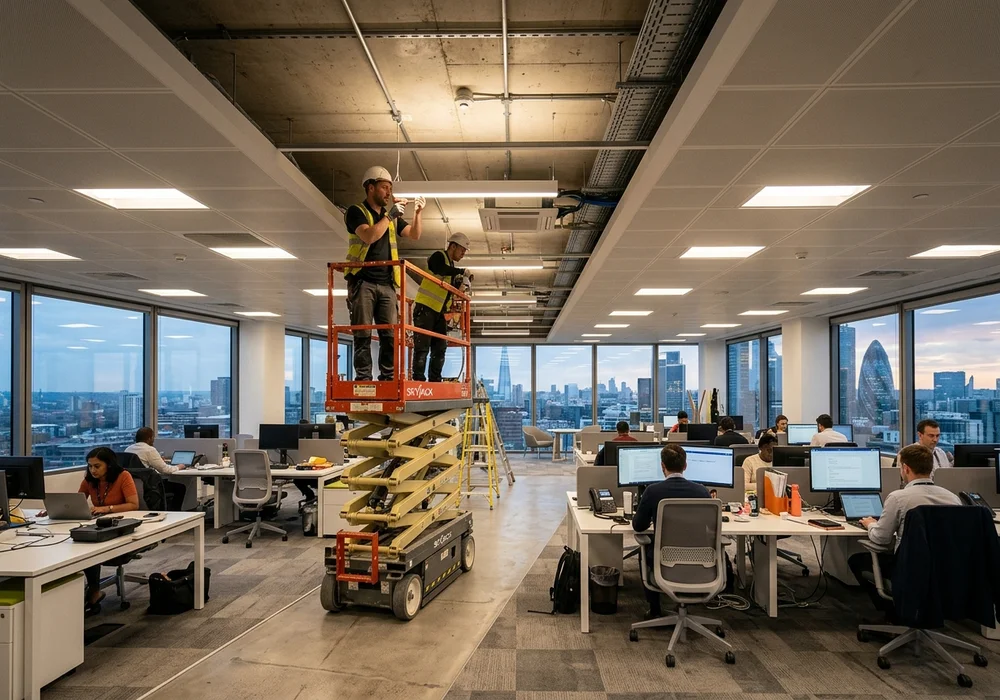
Replacing older lighting systems with LEDs is one of the more straightforward energy-efficiency upgrades available to commercial building owners. But before starting a retrofit, owners usually want to answer one fundamental question:
How quickly will the investment pay for itself?
The answer depends on the existing lighting system, operating hours, electricity rates, fixture count, controls, labor costs, maintenance savings, and available incentives.
For NYC buildings, LED retrofits can also play a role in Local Law 88 (LL88) compliance. LL88 requires covered buildings to bring applicable lighting systems into compliance with current NYC Energy Conservation Code standards, including lighting power allowances and controls.
The NYC Regulatory Context
Under NYC Local Law 88, commercial lighting upgrades are not merely discretionary energy-saving measures—they are legally mandated capital obligations for covered buildings over 25,000 sq. ft. Understanding true project ROI ensures owners maximize utility incentives, lower operating costs, and meet strict compliance deadlines simultaneously.
What Is an LED Retrofit?
An LED retrofit replaces an existing legacy lighting system (such as fluorescent T8/T12 tubes, high-intensity discharge lamps, or halogen troffers) with modern, high-efficacy solid-state LED technology.
Depending on the building's architecture and existing electrical layout, a retrofit project could involve:
- Direct Lamp Replacement (Type A/Type B LED Tubes): Swapping legacy lamps while retaining existing troffer housings
- Retrofit Kits: Replacing interior reflectors, drivers, and light engines within existing fixture shells
- New Fixture Replacement: Installing high-efficiency architectural linear LED luminaires or modular troffers
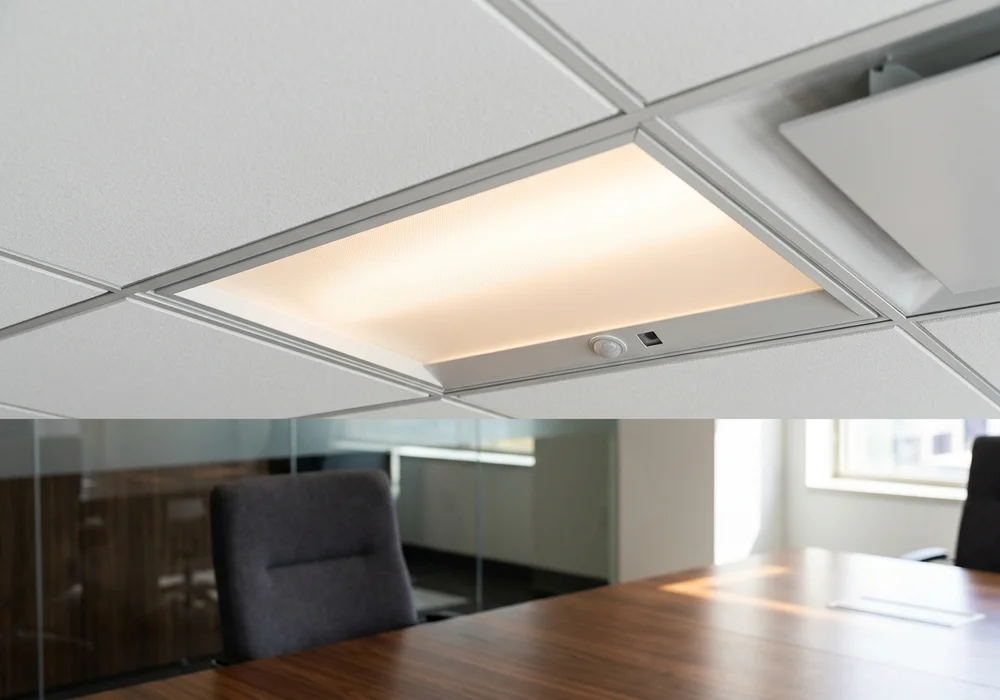
- Integrated Occupancy Sensors: Adding passive infrared (PIR) or ultrasonic occupancy detection
- Daylight-Harvesting Controls: Installing photocells that dim fixtures adjacent to perimeter windows
- Centralized Scheduling & Dimming: Integrating digital lighting controls with Building Automation Systems (BAS)
The scope can range from a relatively simple relamping project to a complete redesign of the building's lighting system.
Why LEDs Can Produce Energy Savings
LEDs generally require substantially less electricity to produce a similar amount of useful light (measured in lumens per watt) than many older lighting technologies.
Consider a simplified commercial example:
Existing: 100 fixtures × 100W = 10 kW
LED Retrofit: 100 fixtures × 40W = 4 kW
Connected Load Reduction: 6 kW (60% Cut)
The actual annual savings then depend on how many hours the lights operate throughout the year.
Basic Energy-Savings Formula
A standard engineering estimate uses the following formula:
Annual kWh Savings Calculation
Formula: Annual kWh savings = Load reduction (kW) × Annual operating hours
Example: 6 kW load reduction × 3,000 operating hours = 18,000 kWh saved per year
This is only an illustration. A real project should use actual fixture wattages, operating schedules, controls, and measured conditions.
How to Calculate LED Retrofit ROI
A basic financial analysis can start with four fundamental numbers:
- Project Cost: Total equipment, labor, disposal, permitting, and engineering design
- Available Incentives: Direct cash rebates from Con Edison or NYSERDA programs
- Annual Energy Savings: Avoided electricity consumption (kWh) and peak demand charges (kW)
- Annual Maintenance Savings: Avoided replacement lamps, ballasts, and dedicated electrician labor
The simple payback period is calculated as follows:
Net Investment = Project Cost − Incentives
Annual Financial Savings = Energy Savings + Maintenance Savings
Simple Payback = Net Investment ÷ Annual Financial Savings
Annual Financial Savings = Energy Savings + Maintenance Savings
Simple Payback = Net Investment ÷ Annual Financial Savings
| Financial Factor | Commercial Example Value |
|---|---|
| Gross Retrofit Cost | $60,000 |
| Utility Rebates & Incentives | -$10,000 |
| Net Capital Investment | $50,000 |
| Annual Electricity Cost Savings | $12,000 |
| Annual Avoided Maintenance & Labor | $3,000 |
| Total Annual Financial Savings | $15,000 / year |
| Calculated Simple Payback Period | 3.3 Years |
This is an illustration, not a guaranteed result for a particular building. Individual building results vary based on tariff schedules and runtimes.
Energy Savings Are Only Part of the ROI
One common mistake is calculating LED ROI using electricity bill savings alone. In reality, avoided maintenance represents a significant portion of project returns.
Older fluorescent and metal-halide fixtures require continuous operational upkeep:
- Frequent replacement of short-lived lamps (fluorescents last 10,000–20,000 hours vs. LEDs at 50,000–100,000 hours)
- Renting expensive scissor lifts or staging scaffolding for double-height atriums and exterior parking areas
- Replacing burned-out electronic ballasts and ignitors
- Hazardous waste disposal costs for mercury-containing fluorescent tubes under EPA and DEC regulations
- Paying premium after-hours overtime labor rates to avoid disrupting tenant business hours
For buildings with difficult-to-access fixtures—such as high-ceiling lobbies, parking garages, loading docks, or stairwells—maintenance savings can constitute 20% to 35% of total project ROI.
Lighting Controls Can Drastically Improve the ROI
Replacing fixtures is only one part of an efficient lighting strategy. Adding advanced controls reduces total operating hours by responding dynamically to occupancy and natural daylight.
Old System: Inefficient fixtures + Fixed 24/7 run schedule
Upgraded: High-efficiency LEDs + Occupancy sensors + Daylight harvesting
Upgraded: High-efficiency LEDs + Occupancy sensors + Daylight harvesting
The upgraded system saves dramatically more electricity because it cuts both lighting power draw (watts) and unnecessary operating runtime (hours).
This is particularly relevant to NYC LL88 because covered lighting systems must meet applicable lighting power densities (LPD) and mandatory control requirements (including automatic shutoff, bi-level switching, and daylight-responsive dimming).
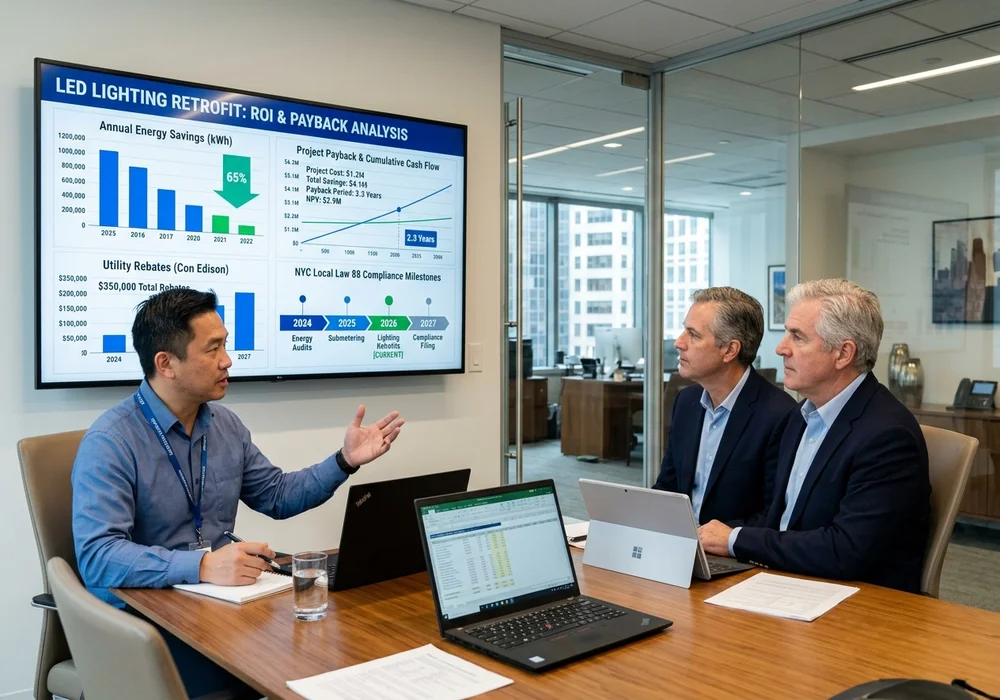
What Key Factors Determine LED Retrofit ROI?
1. Existing Lighting Technology
The larger the efficiency delta between existing lamps and new LEDs, the faster the payback. Replacing 400W metal halides in a garage yields far faster returns than replacing relatively modern T5 fluorescents.
2. Annual Operating Hours
A fixture operating 24/7 (8,760 hours/year in stairwells and garages) saves nearly four times more electricity annually than an office fixture running 2,200 hours per year.
3. Blended Electricity Rates
NYC commercial electricity costs are among the highest in the country ($0.20 to $0.28+ per kWh). High electricity rates shorten payback periods compared to national averages.
4. Total Fixture Count & Economies of Scale
Bulk purchasing and streamlined installation staging lower the per-fixture cost for large properties, accelerating cumulative portfolio payback.
5. Smart Control Integration
Adding daylight harvesting, bi-level dimming, and motion sensors reduces run hours, capturing an additional 15% to 30% in energy savings.
6. Labor and Installation Logistics
Ceiling access, lift requirements, hazardous material disposal, union labor rates, and off-hours scheduling impact the initial capital expense.
LED Retrofit ROI by Building Type
Different building occupancy classifications exhibit distinct lighting usage profiles and payback dynamics:
| Building Type | Typical Operating Profile | Primary ROI Drivers | Average Payback |
|---|---|---|---|
| Commercial Office | 2,500–3,500 hours/yr | High fixture density, occupancy sensors, LL88 tenant compliance | 2.5 – 4.0 Years |
| Retail Properties | 3,500–5,000 hours/yr | Long operating schedules, high color rendering (CRI), reduced HVAC heat | 1.5 – 3.0 Years |
| Warehouses & Logistics | 4,000–8,760 hours/yr | High-bay fixture wattage drops (400W to 120W), aisle motion sensors | 1.2 – 2.5 Years |
| Hotels & Hospitality | 4,000–8,760 hours/yr | 24/7 corridor and lobby lighting, guestroom aesthetic upgrades | 2.0 – 3.5 Years |
| Multifamily Residential | 3,000–8,760 hours/yr | Continuous stairwell, hallway, and exterior facade lighting | 1.8 – 3.2 Years |
| Parking Garages | 8,760 hours/yr (24/7) | Round-the-clock operation, bi-level motion dimming, extreme maintenance cuts | 0.9 – 2.0 Years |
The most attractive retrofit opportunities are not necessarily buildings with the largest gross square footage. They are properties where long operating hours, inefficient legacy equipment, and controllable loads overlap.
How NYC Local Law 88 (LL88) Changes the Analysis
For covered NYC buildings, lighting upgrades are not merely an optional energy-efficiency project. LL88 requires applicable lighting systems in covered buildings (over 25,000 gross sq. ft.) to comply with current NYC Energy Conservation Code standards.
The City requires compliance to be formally certified by a Registered Design Professional (PE or RA), Licensed Master Electrician, or Licensed Special Electrician.
Consequently, building owners should evaluate LED upgrades alongside the building's compliance roadmap. Instead of asking:
"Should we install LEDs?"
The strategic question is:
"What lighting configuration gives us the best combination of code compliance, maximum energy savings, automated controls, avoided maintenance, and long-term asset value?"
Utility Incentives Substantially Shorten Payback
Available cash incentives can dramatically improve project economics. In New York City, commercial property owners can leverage utility and state programs:
- Con Edison Commercial & Industrial Lighting Program: Offers instant prescriptive and custom rebates for qualifying LED troffers, downlights, high-bays, and networked lighting controls.
- NYSERDA Clean Energy Programs: Provides technical assistance and financing for comprehensive commercial decarbonization projects.
Utility rebates often cover 20% to 50% of the total fixture and material purchase price. Because rebate structures, equipment eligibility, and funding pools change annually, building owners should pre-screen equipment with utility program managers before purchasing fixtures.
Simple Payback vs. Full Lifecycle ROI
While simple payback is intuitive and easy to compute, it fails to capture the full financial lifecycle of a capital asset. For larger commercial portfolios, financial analysts evaluate:
- Net Present Value (NPV): Discounting future cumulative utility bill savings to present-day dollars
- Internal Rate of Return (IRR): Demonstrating that LED retrofits frequently deliver internal rates of return exceeding 25% to 45%
- Local Law 97 Carbon Penalty Avoidance: Lowering building electricity consumption directly cuts Scope 2 emissions, avoiding $268/ton fines starting in 2024–2030
- Cooling Load Reduction: Because LEDs emit far less waste heat than fluorescents, summer air conditioning chiller loads drop by 1 ton for every 3 kW of lighting reduced
Case Study: Comparing Two Commercial Retrofit Projects
To illustrate why operating schedules dictate project economics, consider two commercial buildings undertaking retrofits with identical upfront capital costs:
| Project Metric | Building A (Standard Office) | Building B (24/7 Facility / Garage) |
|---|---|---|
| Gross Project Cost | $80,000 | $80,000 |
| Annual Operating Hours | 2,000 hours / year | 4,500 hours / year |
| Estimated Annual Energy Savings | $10,000 / year | $22,000 / year |
| Annual Avoided Maintenance | $2,000 / year | $5,000 / year |
| Total Annual Financial Savings | $12,000 / year | $27,000 / year |
| Calculated Simple Payback | 6.7 Years | 3.0 Years |
Building B achieves payback in less than half the time simply because its fixtures run more hours per day. This illustrates why fixture count alone is an unreliable metric for estimating ROI.
When Should Building Owners Prioritize an LED Retrofit?
A comprehensive lighting retrofit should be prioritized immediately when:
- Existing fixtures are predominantly T12, T8 fluorescent, or metal-halide technology
- Fixtures operate more than 3,000 hours annually (lobbies, corridors, garages, stairwells)
- Maintenance staff spends substantial weekly hours changing burned-out tubes and ballasts
- Lighting controls are manual toggle switches without automatic shutoff or vacancy sensing
- The property is preparing its mandatory Local Law 88 lighting compliance filing
- Con Edison rebate incentives are active for the proposed fixture categories
LED Retrofit ROI Checklist
Conduct a comprehensive fixture audit recording lamp types, wattages, and baseline condition.
Verify actual operating schedules by space type rather than relying on assumed hours.
Analyze current blended electricity rates ($/kWh) and peak demand charges ($/kW).
Quantify historical annual replacement lamp, ballast, and electrician maintenance costs.
Evaluate integrated occupancy sensors, bi-level dimming, and daylight harvesting options.
Confirm applicable NYC Local Law 88 lighting power density and control requirements.
Pre-apply for Con Edison and NYSERDA commercial lighting incentives before purchasing fixtures.
Obtain competitive turnkey contractor proposals covering equipment, installation, and disposal.
Calculate net project investment, simple payback period, and lifecycle NPV.
Have a Licensed Electrician or Registered Design Professional certify LL88 compliance upon completion.
Common LED ROI Mistakes to Avoid
Assuming Every Project Pays Back in Under 2 Years: Payback depends directly on operating hours; low-use private offices take longer to pay back than 24/7 common areas.
Omitting Lighting Controls: Swapping fixtures without installing occupancy or daylight sensors forfeits substantial ongoing energy savings and risks LL88 non-compliance.
Neglecting Avoided Maintenance in Financial Models: Failing to include reduced labor and replacement lamp costs significantly underestimates the true economic return.
Applying for Utility Rebates Too Late: Many utility programs require pre-approval before equipment is ordered or installed; purchasing first can disqualify the project from receiving thousands in rebates.
Overlooking Color Temperature & Light Quality: Purchasing low-CRI or harsh blue-tinted LEDs can trigger tenant dissatisfaction; specify 3500K–4000K warm-white architectural LEDs.
Conclusion
LED retrofit ROI depends on far more than the sticker price of new light fixtures. Commercial building owners must evaluate existing fixture efficiency, operating schedules, electricity rates, avoided maintenance, automated controls, contractor labor, utility incentives, and local compliance standards.
For NYC properties, Local Law 88 makes lighting upgrades an urgent priority because covered buildings must meet modern energy code lighting standards and certify compliance.
When properly designed and executed, an LED retrofit delivers a compelling multi-part return: 50% to 75% electricity reductions, virtually eliminated routine maintenance, improved visual comfort, and verified compliance with NYC energy mandates.
Frequently Asked Questions
There is no universal payback period. Projects with high operating hours, inefficient existing lighting, and significant maintenance costs can achieve payback in 2 to 4 years, whereas low-use spaces may take longer. A building-specific calculation is far more useful than a generic estimate.
Start with net project cost (total project expense minus utility and NYSERDA rebates) and divide by annual financial savings (annual electricity savings plus avoided lamp/ballast maintenance expenses).
Yes. LEDs consume 50% to 75% less electricity than older fluorescent or HID lighting while reducing cooling loads on air conditioning systems.
Yes. Occupancy sensors, scheduling, dimming, and daylight-responsive controls can reduce operating hours and energy waste by an additional 20% to 40%.
LL88 requires applicable lighting systems in covered buildings to meet current NYC Energy Conservation Code standards for lighting power density and controls. While LED technology is the standard method to achieve compliance, the code governs lighting power allowances rather than mandating a specific brand or technology.
Yes. Con Edison and NYSERDA provide substantial commercial lighting and controls rebates that can offset 20% to 50% or more of project equipment and installation costs.