BY NYC Energy Code Team
ON 14 Jul 2026
NYC Local Law 152
F Energy Grade for NYC Buildings: What It Means and Why Owners Should Pay Attention
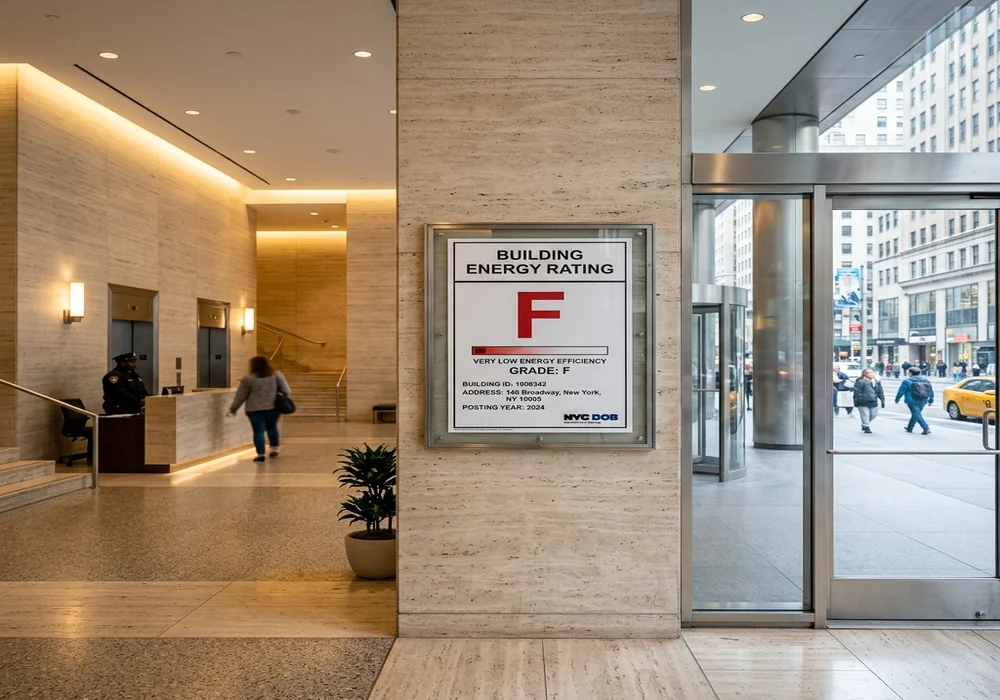
Many New York City building owners first notice their building's energy grade when it appears in the lobby or becomes part of conversations with tenants, brokers, board members, or prospective buyers.
Most people naturally focus on the letter itself. An A appears positive. A B or C may seem acceptable. An F immediately raises questions.
For some owners, the first reaction is embarrassment. However, an F energy grade is not simply a public relations issue. Depending on the circumstances, it may indicate that required benchmarking information was not properly submitted, that reporting requirements were not satisfied, or that the building's energy performance requires closer attention.
Because NYC energy grades are publicly displayed for covered buildings, they influence more than compliance records. They may affect how tenants, investors, lenders, buyers, and management teams perceive the property.
Understanding the implications of an F energy grade NYC building helps owners determine whether the issue involves reporting, benchmarking, operational performance, or a combination of several factors.
Why NYC Uses Building Energy Grades
New York City introduced building energy grades to improve transparency regarding the energy performance of larger buildings. Rather than keeping energy information available only to owners or government agencies, the grading system allows members of the public to view a building's posted energy grade.
The purpose is to encourage:
- Greater awareness of building energy performance.
- Better energy management.
- Increased transparency.
- More informed decision-making by occupants and prospective tenants.
For covered properties, the grade becomes part of the building's public profile.
Why an F Grade Gets Attention
Unlike many compliance issues that remain buried within administrative databases, energy grades are designed to be visible.
People who may notice the grade include:
- Tenants and visitors.
- Prospective renters and commercial tenants.
- Real estate brokers, buyers, and investors.
- Board members, property managers, and building staff.
Because the grade is publicly displayed, it often becomes part of broader conversations about building operations.
An F Grade Is Not Always About Energy Waste Alone
One of the biggest misconceptions is that an F automatically means the building consumes excessive energy. That is not always the case.
An F grade may sometimes reflect:
- Missing benchmarking submissions.
- Reporting deficiencies or administrative compliance issues.
- Problems with required data.
- Operational energy performance.
Owners should identify the actual cause before assuming the building performs poorly.
Why Benchmarking Matters
Benchmarking is an important component of NYC's building energy programs. Benchmarking generally involves collecting and reporting building energy information according to applicable requirements.
Accurate benchmarking supports:
- Performance evaluation.
- Energy planning and optimization.
- Public transparency.
- Compliance with reporting obligations.
If benchmarking requirements are not completed correctly, the building's public records may be affected.

Missing Benchmarking Can Lead to Bigger Questions
Owners sometimes treat benchmarking as routine paperwork. However, incomplete reporting may raise broader questions.
For example, owners should ask:
- Was the required report submitted and accepted?
- Was complete and accurate information provided?
- Was the reporting deadline met?
- Were all administrative requirements resolved?
If these questions remain unresolved, the resulting energy grade may reflect administrative issues rather than building operations alone.
Why Owners Should Not Ignore an F Grade
Some owners believe that the energy grade affects only public image. In reality, it may also influence:
- Compliance reviews and DOB records.
- Building management decisions and capital planning.
- Energy improvement projects.
- Tenant discussions and property transactions.
Ignoring the underlying issue allows uncertainty to continue. Reviewing the cause provides a clearer path forward.
Confirming and Verifying Benchmarking Requirements
The first step is determining whether the building was subject to benchmarking requirements. Owners should verify whether the property was covered, whether benchmarking was required, whether the submission deadline applied, and whether the report was filed. Beginning with these questions often simplifies later investigation.
If benchmarking was required, confirm that the report was completed, the submission was transmitted, the agency accepted the filing, and no outstanding reporting issues remain. Owners should avoid assuming that a completed report automatically means the submission process was successfully finished.
Review the Submitted Data
Accurate reporting depends on accurate information. Owners should review whether submitted data appears complete and consistent.
Questions may include:
- Were all required energy sources included?
- Were building characteristics reported accurately?
- Was the reporting period correct?
- Was supporting information complete?
Reviewing data quality helps identify administrative problems before they affect future reporting.
Was the Energy Grade Posted Correctly?
Covered buildings are generally required to display the assigned energy grade. Owners should verify the correct grade is displayed, the current label is being used, and the posting location complies with applicable requirements. Maintaining accurate postings supports transparency and compliance.
Why Public Perception and Leasing Conversations Matter
Because the grade is visible, people often draw conclusions before asking questions. A prospective tenant may wonder whether the building is efficiently managed, operating costs are high, or maintenance is being performed appropriately. A lender may ask about building management practices, while a board member may request additional information regarding energy planning. Although the grade represents only one aspect of building management, it often becomes part of broader discussions.
Commercial and residential tenants increasingly consider building sustainability when evaluating properties. Visible energy information may influence leasing discussions, tenant expectations, corporate sustainability goals, and occupant confidence. Owners who understand their building's energy records can respond more effectively to questions.
Why Boards and Buyers Pay Attention
Condominium and cooperative boards often review capital improvements, operating expenses, energy costs, and compliance obligations. An F grade may encourage discussions about future building investments, reporting accuracy, or operational improvements.
During due diligence, prospective buyers frequently evaluate building operating costs, capital needs, compliance history, and energy reporting. An unexplained F grade may prompt requests for additional documentation. Well-organized records help answer these questions more efficiently.
What Owners Should Review & Build
If your building receives an F grade, gather benchmarking reports, submission confirmations, utility information, energy records, building characteristics, previous energy grades, correspondence regarding reporting, and compliance documentation. Organized records make it easier to determine whether the issue involves reporting or building performance.
Furthermore, owners should maintain a dedicated energy documentation folder. Include benchmarking submissions, filing confirmations, utility records, energy reports, building characteristics, previous grades, correspondence, and improvement plans. Consistent recordkeeping simplifies future reporting.

Why Capital Planning May Be Affected
If energy performance improvements are eventually considered, owners may review projects involving lighting upgrades, HVAC improvements, building controls, insulation improvements, window replacements, or equipment modernization. Planning should be based on accurate building information rather than assumptions.
Administrative Problems vs. Operational Problems
One important distinction is identifying whether the F grade resulted from missing reporting, administrative issues, incomplete benchmarking, or actual building energy performance. Administrative issues may often be addressed through improved documentation and reporting. Operational improvements typically involve longer-term planning. Understanding the cause prevents unnecessary confusion.
Common Mistakes Owners Make
Several recurring mistakes appear regularly. These include:
- Ignoring the posted grade.
- Assuming an F always means inefficient operations.
- Not confirming benchmarking requirements.
- Losing submission confirmations.
- Failing to review reported data.
- Treating the grade only as a marketing issue.
- Waiting until the next reporting cycle.
Most of these problems are avoidable through organized recordkeeping.
Best Practices for Building Owners
Owners can strengthen energy compliance by:
- Confirming benchmarking requirements annually.
- Maintaining organized energy records.
- Reviewing submissions before deadlines.
- Keeping utility documentation.
- Monitoring reporting status and saving confirmation receipts.
- Reviewing posted grades and planning future improvements thoughtfully.
Consistent documentation supports both compliance and building management.
F Energy Grade Review Checklist
If your building displays an F grade, verify the following:
- ✔ Benchmarking requirement confirmed
- ✔ Report submitted and accepted
- ✔ Utility data and building information verified
- ✔ Energy grade posted correctly
- ✔ Documentation organized and previous records available
- ✔ Future reporting calendar updated and improvement opportunities reviewed
Using a checklist helps owners identify whether the issue involves compliance, reporting, operational performance, or several factors together.
Practical Takeaway
An F energy grade should not automatically be viewed as a permanent label or simply a public embarrassment. Instead, it should serve as a prompt to investigate the building's records. Begin by confirming whether benchmarking was required, whether reporting was completed, whether the submission was accepted, and whether the displayed grade accurately reflects the building's current compliance status.
Only after understanding the underlying cause can owners decide whether improvements involve administrative corrections, operational changes, or both.
Conclusion
Understanding the meaning of an F energy grade NYC building helps owners move beyond the letter itself and focus on the underlying issue. Because energy grades are publicly displayed, they influence how tenants, buyers, lenders, and management teams perceive a property. However, an F grade does not always indicate poor energy performance. In some cases, it may reflect missing benchmarking information, reporting deficiencies, or other administrative compliance issues.
The most effective response is not to ignore the grade or assume the worst. Instead, owners should review benchmarking obligations, confirm that required reports were submitted and accepted, verify the accuracy of building data, and maintain organized records for future reporting cycles. Treating the grade as an opportunity to improve documentation and long-term energy planning is often more productive than viewing it as simply an image problem.
Frequently Asked Questions
What does an F energy grade mean?
An F energy grade may indicate missing benchmarking submissions, reporting deficiencies, or building energy performance issues. Owners should review the underlying cause rather than relying solely on the letter grade.
Is an F grade publicly displayed?
Yes. Covered NYC buildings are generally required to post their assigned energy grade where it can be seen by occupants and visitors.
What should owners check first?
Confirm whether the building was required to benchmark, whether the benchmarking report was submitted, whether it was accepted, and whether the posted grade accurately reflects the building's compliance status.
Does an F grade always mean the building wastes energy?
Not necessarily. Some F grades may result from administrative or reporting issues rather than actual building energy performance.
What records should owners keep?
Maintain benchmarking reports, utility records, submission confirmations, previous energy grades, compliance correspondence, and related documentation.
Where should owners review energy compliance information?
Owners should begin by reviewing the appropriate NYC benchmarking and energy reporting records along with the building's compliance documentation. Additional property information may also be available through the DOB NOW Public Portal, the Building Information System (BIS), and NYC Open Data where applicable.
You may also
like