Learn how commercial buildings in NYC use occupancy sensors and smart controls to cut HVAC and lighting energy waste.
BY NYC Energy Code Team
ON
27 September 2026
Digital Twins in Building Management: A Beginner's Guide
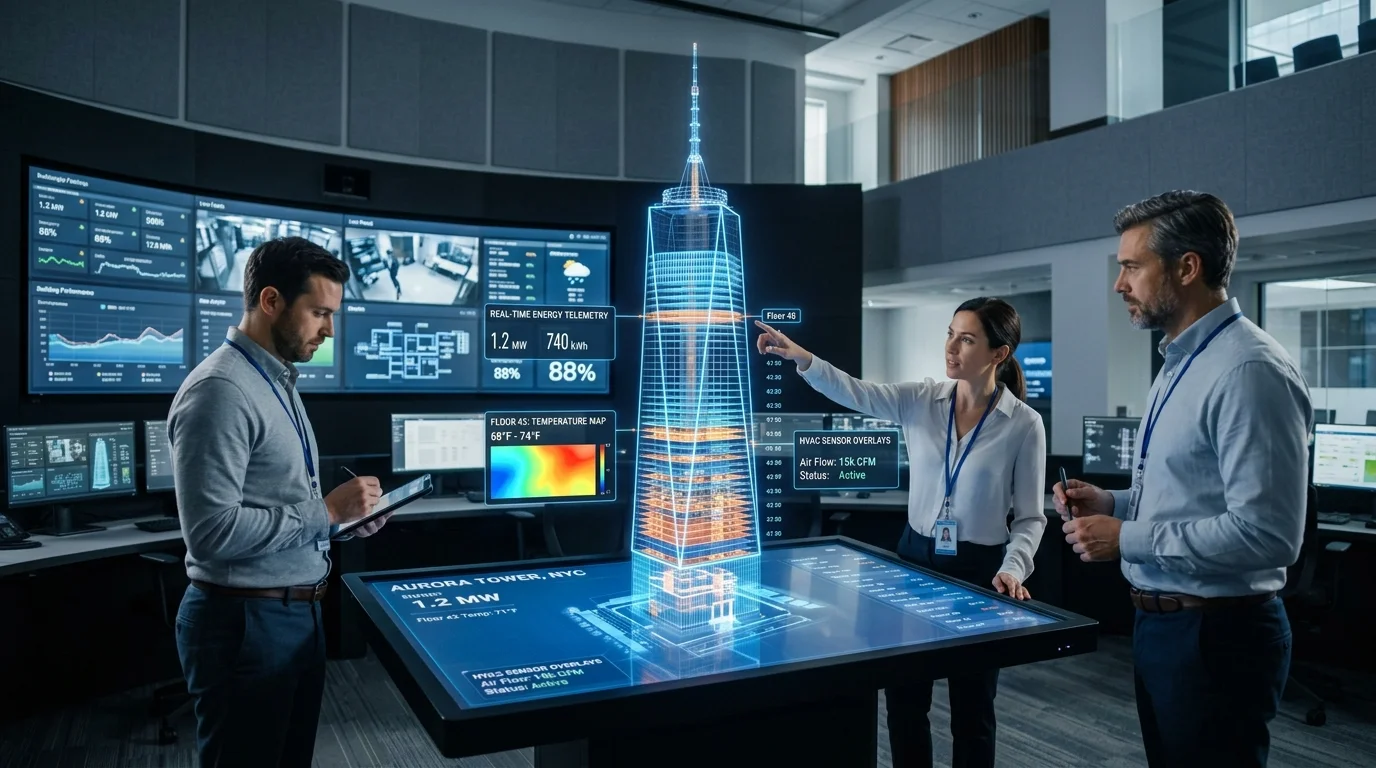
A building manager normally has to piece together information from several places: the building automation system, equipment manuals, floor plans, utility bills, maintenance records, and spreadsheets.
A digital twin brings much of that information into a connected digital representation of the physical building.
The concept goes beyond creating a 3D model. A useful building digital twin can combine information about the building's systems with operational data, allowing managers to understand how the physical property is performing and, in more advanced applications, test or predict what might happen next.
NIST describes a digital twin as a computer model of a physical system, such as a building, with the potential to model different aspects of that system with high accuracy and support forecasting, monitoring, optimization, and decision-making.
What Is a Building Digital Twin?
Think of a digital twin as a living digital representation of a building.
A traditional drawing tells you:
“There is an air-handling unit here.”
A digital twin can potentially tell you:
“This air-handling unit serves these spaces, is currently operating at this condition, and its energy behavior has changed compared with its normal pattern.”
That difference is important.
A basic BIM model primarily describes what was designed or constructed. A digital twin is intended to connect the digital representation with information about the real physical system and its behavior over time.
The sophistication of that connection varies from project to project.
What Goes Into a Digital Twin?
There is no single required technology stack.
A building twin may combine information from:
BIM or CAD → equipment records → sensors → meters → building automation → maintenance data → weather → analytics
For example, a commercial building might connect:
- HVAC equipment
- Temperature sensors
- Electricity meters
- Occupancy information
- Building automation controls
- Equipment schedules
- Floor plans
The result can give the operations team a common digital view of the building.
DOE research similarly emphasizes that building data becomes more valuable when energy-use information can be correlated with physical assets and building activities rather than being viewed only as a utility-meter number.
Digital Twin vs. BIM
These technologies are closely related but not identical.
| BIM | Digital Twin |
|---|---|
| Primarily represents design and construction information | Represents the physical asset and potentially its ongoing behavior |
| Often static or periodically updated | Can incorporate continuously or periodically updated operational data |
| Strong for documentation and coordination | Strong for monitoring, analysis, simulation, and decision support |
| Commonly used during design/construction | Can extend through operations |
| Describes the asset | Can help describe and predict how the asset behaves |
A BIM model can therefore become an important foundation for a digital twin, but a BIM file by itself is not necessarily a digital twin.
How Sensors Bring a Twin to Life
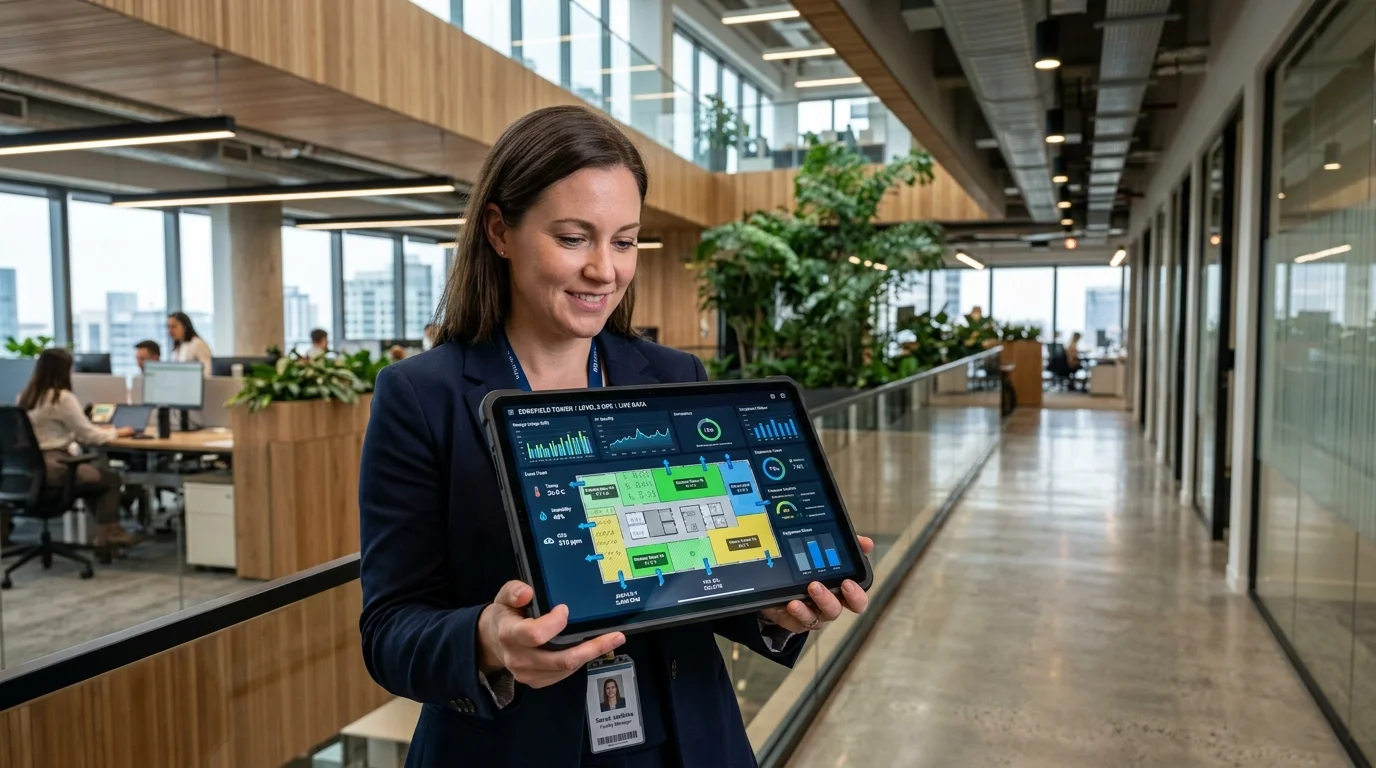
A digital twin becomes much more useful when it receives current information from the physical building.
For example:
- Temperature sensor → digital twin
- Electric meter → digital twin
- Chiller status → digital twin
- Occupancy information → digital twin
The software can then combine these inputs to create a more complete picture of what is happening.
Imagine a building's cooling energy suddenly increases.
A conventional dashboard might show:
Electricity consumption ↑
A connected digital twin could potentially provide additional context:
Outdoor temperature ↑ + occupancy ↑ + chiller runtime ↑ + supply-air temperature changed
That additional context can make troubleshooting faster.
Digital Twins and Energy Management
Energy optimization is one of the most interesting applications.
DOE describes emerging energy-management systems that use automated models, including digital twins and related statistical models, to continuously compare predicted and actual energy use. These systems can support anomaly detection and help identify changes in consumption.
A simple workflow might look like:
Normal building behavior → model establishes expected performance → actual performance deviates → system flags anomaly → operator investigates
For example, if an air-handling system is consuming significantly more energy than expected under similar operating conditions, the twin can help draw attention to the issue.
It does not necessarily tell the operator the exact cause automatically. It provides a smarter starting point for investigation.
Predictive Maintenance
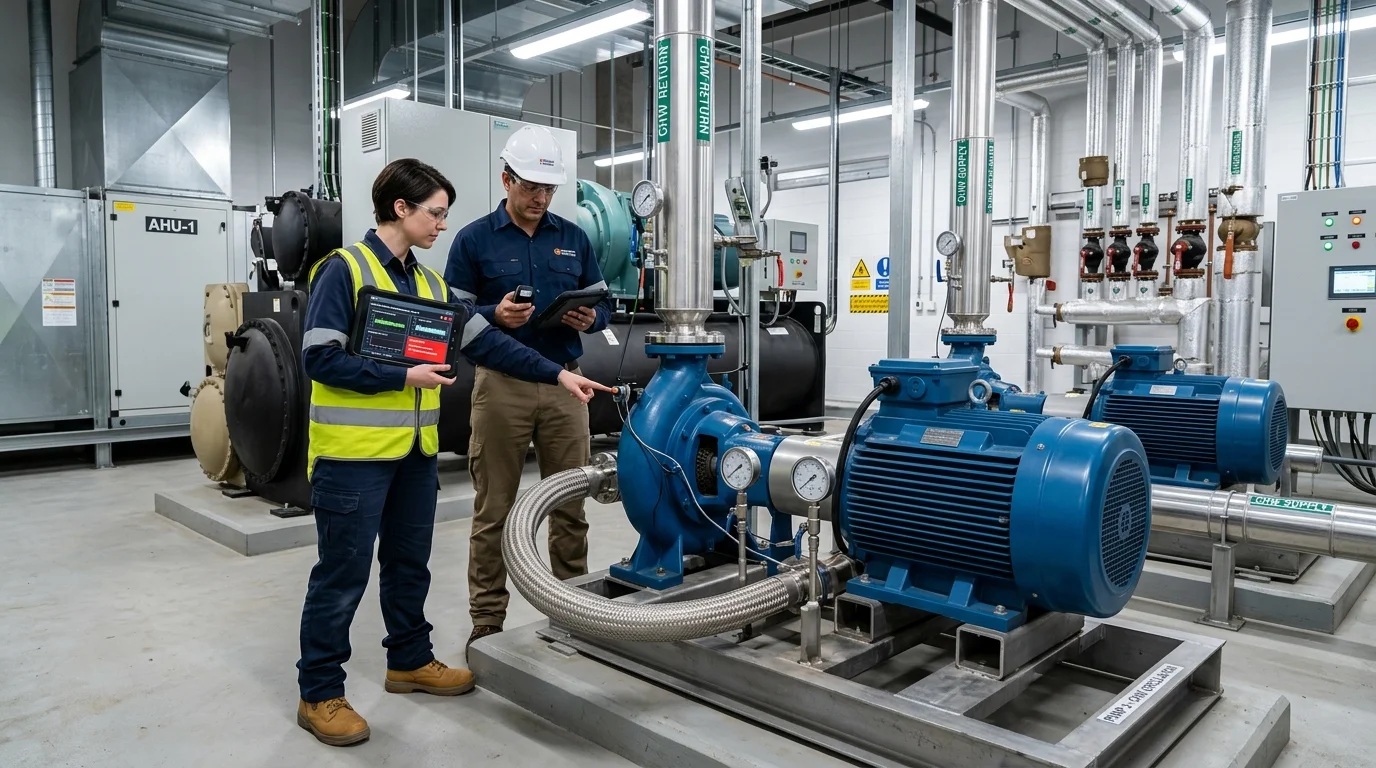
Digital twins can also support maintenance decisions.
Instead of relying entirely on fixed maintenance intervals, operators can look at how equipment is actually behaving.
Suppose a pump normally operates within a particular range.
Over time:
Normal vibration/temperature/energy pattern
becomes:
Increasing deviation
That change could trigger further inspection.
The objective is not to replace technicians with software. It is to use operational data to identify where human attention may be needed.
NIST highlights forecasting as a foundational capability of digital twins and notes potential applications in reducing inefficiencies and losses.
Testing “What If?” Scenarios
One of the more advanced uses of a digital twin is scenario testing.
A building owner could ask:
What happens if we change the HVAC schedule?
Or:
What happens if cooling setpoints increase by two degrees?
Or:
What happens if we electrify the heating system?
Instead of experimenting directly on the operating building, the team can first use a suitable model to estimate possible outcomes.
This is closely related to building energy modeling. DOE describes building-energy models as physics-based simulations that can be used to evaluate design and retrofit options and, in emerging applications, support short-term control decisions using real-time information.
The distinction is that a digital twin can be connected to the ongoing state of the actual building, rather than representing only a proposed design.
A Practical Example
Consider a 15-story office building.
The property has:
- A building automation system
- Several air-handling units
- Electricity submeters
- Temperature sensors
- An existing BIM model
- Maintenance records
The owner creates a digital twin that connects these sources.
One afternoon, the system detects that electricity consumption in one zone is significantly higher than expected.
The digital twin shows:
- Occupancy → normal
- Outdoor temperature → normal
- Lighting → normal
- HVAC runtime → unusually high
The facility team investigates and discovers a control problem causing an air-handling unit to operate longer than intended.
The twin did not repair the fault. It helped the team find the abnormal behavior faster.
Digital Twins for Retrofit Planning
Digital twins can also become useful during major energy retrofit projects.
DOE is currently supporting research that uses automatically generated digital twins of existing building facades to support retrofit design. In one project, Oak Ridge National Laboratory used point-cloud data to create a digital representation of existing buildings and use it in retrofit planning.
This illustrates an important idea:
The digital twin does not have to begin with perfect documentation.
It can be built from combinations of existing drawings, scans, surveys, equipment information, and operational data.
For older buildings with incomplete records, that can be particularly valuable.
Digital Twins and Building Automation
A digital twin and a building automation system perform different jobs.
The BAS controls physical equipment.
The digital twin can provide a model and analytical layer that helps interpret what the equipment is doing.
Conceptually:
Sensors → BAS/data platform → digital twin/analytics → insight → control or maintenance decision
Advanced systems can move toward automated optimization, but the level of automation should match the reliability of the underlying data and controls.
DOE is actively working on standards and interoperability approaches because building controls and analytics systems are often difficult to configure across different buildings and equipment platforms.
Do You Need a Digital Twin for Every Building?
No.
A digital twin can be powerful, but it is not automatically the best investment for every property.
A smaller building with simple equipment may get more value from:
Reliable meters + good controls + clear dashboards
than from a highly sophisticated twin.
The business case becomes more interesting when the building has:
Complex systems + large energy costs + extensive sensor data + many equipment assets + significant operational complexity
In those situations, the ability to connect data and model building behavior can provide greater value.
The Data Quality Problem
A digital twin is only as reliable as its underlying information.
Poor sensor calibration, missing equipment data, incorrect floor plans, disconnected meters, and outdated asset records can undermine the system.
Consider a simple example:
Sensor says 72°F
But the sensor is actually reading 76°F because it has drifted.
A sophisticated analytics platform can still produce a technically impressive result from the wrong input.
This is why sensor calibration, data validation, asset identification, and system commissioning are fundamental parts of a successful digital-twin implementation.
Cybersecurity and Data Governance
Connecting building systems to digital platforms also introduces cybersecurity and data-management considerations.
Owners should know:
- What data is being collected?
- Who can access it?
- Where is it stored?
- Which systems can communicate with it?
- Can vendors access building controls remotely?
A digital twin should therefore be treated as part of the property's technology infrastructure, not simply as a visualization tool.
A Smart Way to Start
Building owners do not need to create a sophisticated digital twin on day one.
A practical progression is:
1
Organize Asset and Building Data
Gather equipment inventories, operating manuals, floor plans, and maintenance schedules into an accessible repository.
2
Connect Reliable Meter and Sensor Information
Verify utility meters, submeters, and critical space sensors to establish calibrated, reliable live telemetry feeds.
3
Establish Dashboards and Basic Analytics
Deploy operational dashboards to give facility teams clear visibility into real-time building performance trends.
4
Add Models for Energy and Equipment Behavior
Integrate engineering and statistical models to establish baseline performance expectations and flag anomalies.
5
Introduce Predictive or Scenario-Based Capabilities
Implement predictive maintenance and “what-if” scenario simulations where they provide measurable operational value.
This approach reduces the risk of spending heavily on software before the building has clean, usable data.
Common Digital Twin Mistakes
Starting With a 3D Model Instead of a Business Problem
A beautiful visualization has limited value if it does not help reduce energy use, improve maintenance, or support better decisions.
Connecting Bad Data
More sensors do not automatically mean better information.
Trying to Automate Everything
Advanced automation should be introduced only after the underlying systems and data are reliable.
Ignoring Interoperability
Different building systems often use different data structures and communication protocols. DOE identifies interoperability as an important challenge in deploying building analytics and controls at scale.
Forgetting the Operations Team
A digital twin should make building management easier, not create another complicated platform that nobody uses.
Digital Twin Evaluation Checklist
Before investing in a digital-twin platform, ask:
- What problem are we solving?
- Which building systems need to be represented?
- What operational data already exists?
- Which sensors or meters are missing?
- How will the model be maintained as the building changes?
- Who will use the information and make decisions from it?
- How will success be measured?
These questions are often more important than choosing the software itself.
Conclusion
A digital twin in building management is best understood as a connected digital representation of a physical building that can combine asset information, real-world data, models, and analytics.
Its value goes beyond a 3D representation. A well-designed twin can help operators understand building performance, identify unusual energy behavior, support maintenance decisions, evaluate retrofit scenarios, and eventually optimize building operations.
But sophistication is not the goal by itself.
For many properties, the most sensible path is to first establish accurate building information, reliable sensors, good metering, and usable controls. Once that foundation exists, digital-twin capabilities can be added where the expected operational or energy benefits justify the investment.
The strongest digital twins are therefore not simply digital copies of buildings. They are decision-making tools connected to the buildings they represent.
Frequently Asked Questions
It is a digital representation of a physical building that can combine information about the building's assets with operational data and models to support monitoring, analysis, forecasting, optimization, or decision-making.
No. BIM primarily organizes information about a building's design and construction, while a digital twin can connect a digital representation with information about the physical asset's ongoing condition and behavior.
It can support energy savings by identifying abnormal consumption, analyzing system performance, and helping operators evaluate or optimize building operation. DOE identifies digital-twin and related modeling approaches as emerging capabilities within energy-management systems.
Not necessarily, but operational sensors and meters make a digital twin significantly more useful for monitoring the actual building. The required level of sensing depends on what the twin is intended to accomplish.
They can support predictive-maintenance strategies by identifying deviations from expected equipment behavior. However, prediction quality depends on data quality, model design, equipment characteristics, and the specific application.
Yes. They can help organize incomplete building information and combine surveys, scans, existing drawings, equipment data, and operating information. DOE-supported retrofit research has demonstrated the use of automatically generated digital twins for existing-building retrofit planning.
No. The investment makes more sense when the building has sufficient complexity, data, equipment, or operational needs to justify it. Simpler buildings may benefit more from reliable metering, controls, and energy dashboards.
Start by defining the problem the twin is expected to solve, then organize asset information, verify meters and sensors, establish data quality, and determine who will use the resulting information. A clear business case should come before selecting a digital-twin platform.