Who Needs to Comply with LL97? A Building Owner's Quick Checklist
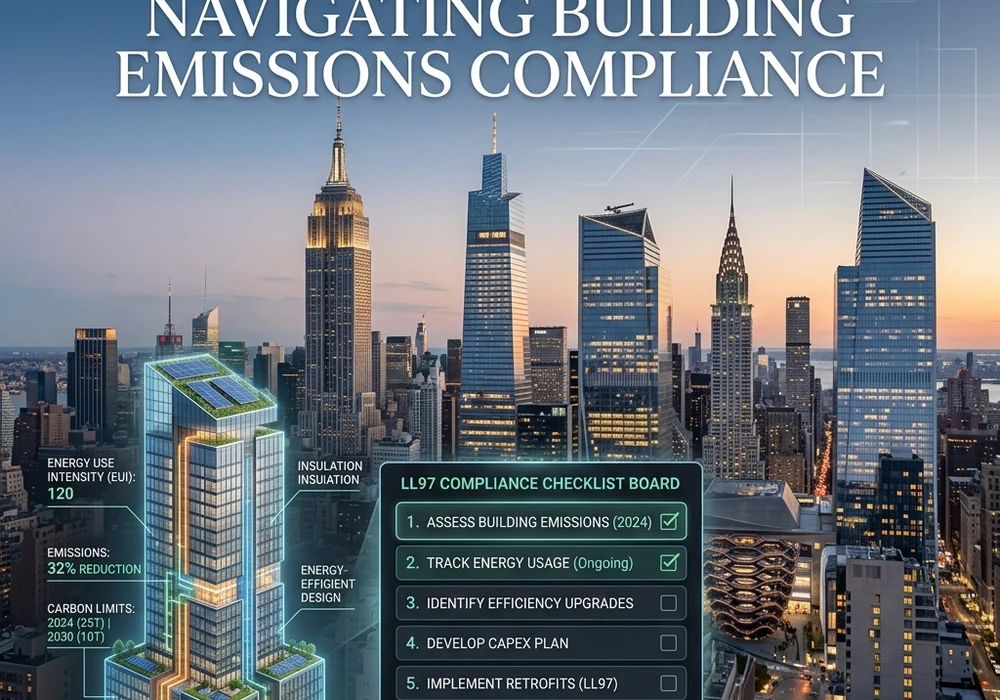
Local Law 97 is one of the biggest energy and emissions rules affecting New York City buildings. But there is one question owners ask before everything else:
Does my building actually have to comply?
The answer isn't always as simple as checking the building's square footage. LL97 coverage depends on the building, tax lot, ownership structure, use, and in some cases a specific compliance pathway or exception.
For 2026, NYC's Department of Buildings has published an updated Covered Buildings List (CBL) that identifies buildings and their preliminary LL97 compliance pathways. Owners are ultimately responsible for verifying that their property's information is accurate.
Here's a practical checklist to help you figure out where your building stands.
What Is Local Law 97?
Local Law 97 is part of New York City's Climate Mobilization Act. It establishes greenhouse gas emissions requirements for certain larger buildings and requires covered owners to demonstrate compliance through the applicable reporting pathway.
The important point is that LL97 isn't simply an energy-efficiency recommendation.
For covered buildings, the law can involve:
- Annual emissions reporting
- Building emissions limits
- Compliance pathways
- Professional reporting
- Energy and emissions data
- Penalties for non-compliance
The exact requirements depend on the building's circumstances.
Step 1: Check Your Building's Size
The first screening question is building size.
Under the standard LL97 coverage definition, a building can be covered if it exceeds 25,000 gross square feet.
There are also situations where multiple buildings on the same tax lot are considered together. Two or more buildings on the same tax lot can fall under LL97 when their combined gross floor area exceeds 50,000 square feet.
Similarly, two or more condominium buildings governed by the same board of managers can be covered when they collectively exceed 50,000 gross square feet.
So don't check only one building in isolation if the property contains multiple buildings.
Step 2: Find Your BBL and BIN
This is where many owners get confused.
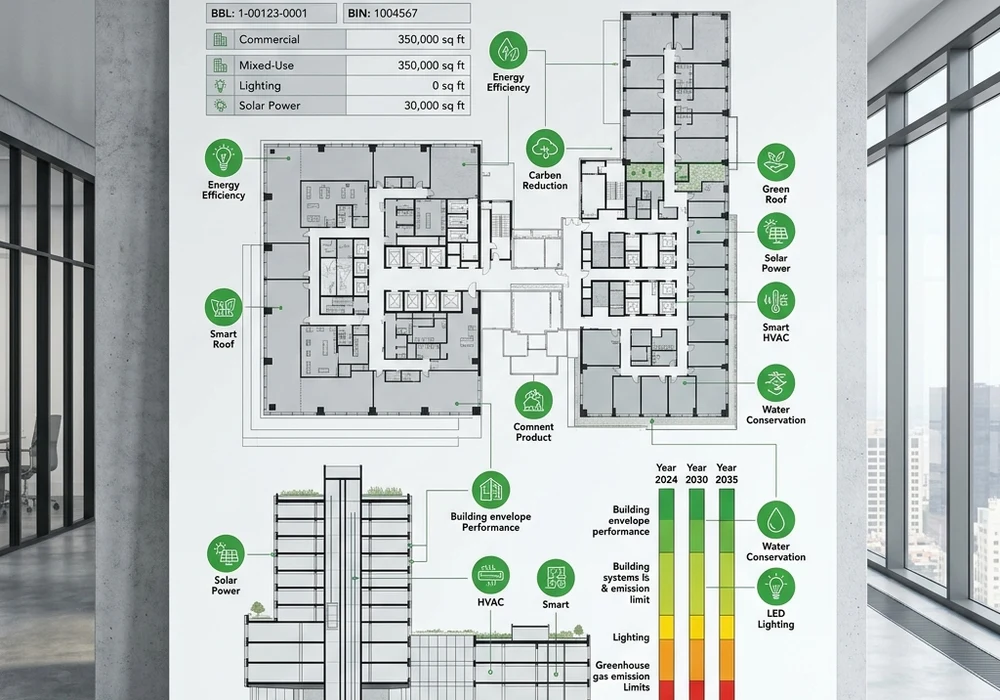
A BBL is the borough-block-and-lot identifier associated with a tax lot.
A BIN, or Building Identification Number, identifies an individual building.
LL97 compliance is ultimately handled at the building level, meaning the BIN matters.
One BBL can contain multiple buildings, and those buildings may not necessarily have identical compliance pathways.
Why this matters
Imagine a tax lot containing three buildings.
The combined property may meet the square-footage threshold, but the three buildings could have different legal characteristics or compliance pathways.
The correct question is: What LL97 compliance pathway applies to this specific BIN?
Step 3: Check the 2026 Covered Buildings List
This should be one of the first things an owner does.
DOB's 2026 Sustainability Laws Covered Buildings List combines information for several sustainability laws, including LL97. The 2026 list provides building-specific information and compliance pathway data.
However, there is an important warning.
Being listed—or not listed—doesn't automatically remove the owner's legal responsibility.
DOB states that owners are responsible for verifying the accuracy of the information used for compliance and reporting.
So use the CBL as a starting point, not as an excuse to stop investigating.
Step 4: Determine Your LL97 Compliance Pathway
Not every covered building follows exactly the same LL97 route.
For 2026, DOB identifies several compliance pathways, including:
Compliance Pathway 0:
Article 320 beginning in 2024
Compliance Pathway 1:
Article 320 beginning in 2026
Compliance Pathway 2:
Article 320 beginning in 2035
Compliance Pathway 3:
Article 321 one-time compliance
Compliance Pathway 4:
City Buildings/NYCHA
The pathway depends on the building's specific characteristics. This is why simply asking, "Is my building over 25,000 square feet?" isn't enough. You also need to know which compliance pathway applies.
Step 5: Check Whether an Exception Applies
Some buildings that otherwise meet the general coverage definition can fall under specific exceptions or alternative treatment.
DOB lists circumstances involving certain:
- Industrial facilities
- Small multi-unit residential arrangements
- City buildings
- NYCHA properties
- Rent-regulated accommodations
- Houses of worship
- Housing Development Fund Company properties
- Buildings participating in certain project-based federal housing programs
The details matter, and an owner shouldn't assume that a building is exempt simply because it belongs to one of these categories.
For example, affordable or rent-regulated housing is not automatically outside LL97. Certain buildings may instead qualify for a different compliance pathway under the law.
Step 6: Don't Confuse "Covered" With "Paying a Penalty"
Another common misunderstanding is that LL97 compliance simply means avoiding a fine.
That's incomplete.
For buildings subject to Article 320, owners generally need to submit the required annual emissions report and meet the applicable annual emissions limit.
For buildings subject to Article 321, the compliance structure is different and can involve demonstrating compliance through the applicable requirements rather than simply comparing annual emissions against an Article 320 limit.
The practical takeaway is simple: First identify the pathway. Then determine what compliance actually requires.
Step 7: Check Your Energy and Emissions Data
Once you've established that LL97 applies, the next question is whether you have the data needed to demonstrate compliance.
Owners should have organized records covering items such as:
- Electricity consumption
- Natural gas usage
- Fuel consumption
- Steam usage
- Building square footage
- Property use
- Utility accounts
- Energy benchmarking information
- Previous LL97 reports
Bad data can create problems even when the building itself is operating reasonably well.
If utility accounts changed, ownership changed, building use changed, or the property was substantially renovated, review the records carefully.
Step 8: Understand the Financial Risk
LL97 isn't just an administrative filing.
For buildings subject to Article 320, DOB currently lists penalties for failing to submit the required annual emissions report and penalties associated with exceeding the applicable emissions limit.
DOB Penalty Structure:
Failure to submit Article 320 annual emissions report:
Floor Area × $0.50 per month
Exceeding applicable emissions limit:
Excess Emissions × $268 per year
Article 321 buildings have different penalty provisions.
The exact financial exposure depends on the building and violation. That is why owners shouldn't wait until a penalty appears before determining their compliance position.
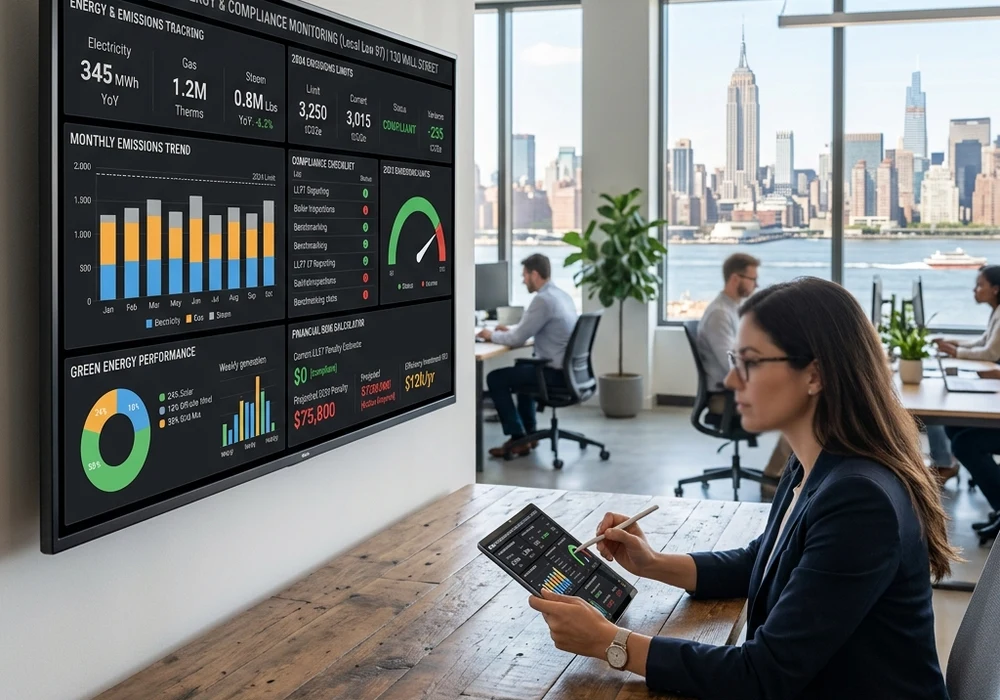
LL97 Quick Checklist for Building Owners
Use this interactive-style checklist as a starting point to audit your property's compliance readiness:
Property Information
- Confirm the building address
- Find the BBL (Borough, Block, Lot)
- Find the BIN (Building Identification Number)
- Confirm gross square footage
- Determine whether multiple buildings share the tax lot
LL97 Status
- Check the 2026 Covered Buildings List
- Confirm whether the building is covered
- Identify the applicable compliance pathway
- Review whether an exception or special circumstance applies
- Check whether the DOB record is accurate
Energy Information
- Collect utility data
- Review energy benchmarking records
- Confirm property-use information
- Review previous emissions reports
- Check for major changes to building operations
Compliance
- Determine the applicable reporting requirement
- Confirm the filing deadline
- Review emissions performance
- Identify potential compliance gaps
- Consult the appropriate professional when necessary
Records
- Save submitted reports
- Save professional certifications
- Keep utility documentation
- Keep DOB correspondence
- Maintain proof of submission
What If Your Building Is Incorrectly Listed?
Mistakes can happen.
DOB specifically provides a process for owners to dispute information on the Covered Buildings List.
If the building is incorrectly listed because of factors such as size, building status, utility information, ownership changes, or another qualifying circumstance, owners can submit a Covered Buildings List dispute through the LL97 Reporting Portal (BEAM).
Don't simply ignore the listing.
If the city record doesn't match the actual building, address the discrepancy and keep documentation showing what you submitted.
What If Your Building Isn't on the List?
Don't immediately assume that means you're exempt.
DOB states that the CBL is a reference tool and that owners remain responsible for determining whether their buildings are subject to LL97.
If your building appears to meet the coverage requirements but doesn't appear correctly on the list, investigate the property record and determine whether a CBL update or dispute is appropriate.
The Biggest Mistake: Treating LL97 Like a One-Time Project
LL97 compliance isn't something you should check once and forget.
Building conditions change. Ownership changes. Tenants change. Energy usage changes. Property records change.
Compliance pathways can also depend on circumstances that need to be properly documented.
For that reason, building owners should treat LL97 as part of their ongoing property-management process.
A simple annual review can include:
1. Check the current CBL
2. Verify the BIN and BBL
3. Confirm the compliance pathway
4. Review energy data
5. Review previous filings
6. Identify upcoming requirements
7. Update the compliance file
That process is considerably easier than reconstructing years of missing information after a problem appears.
Final Takeaway
So, who needs to comply with LL97?
As a starting point, owners of buildings that meet the applicable size and property criteria should assume LL97 needs to be investigated. Buildings over 25,000 gross square feet are within the standard coverage threshold, while certain groups of buildings can also qualify based on combined square footage.
But square footage is only the first step.
You also need to check:
- Your BBL
- Your BIN
- The 2026 Covered Buildings List
- Your compliance pathway
- Potential exceptions
- Your building's actual energy and emissions data
- The reporting requirements that apply to your property
The safest approach is simple: verify first, document everything, and don't assume that another building on the same tax lot has the same LL97 requirements.
Frequently Asked Questions
What size building is subject to LL97?
The standard coverage threshold includes buildings exceeding 25,000 gross square feet. Multiple buildings on the same tax lot can also be covered when their combined area exceeds 50,000 square feet, subject to the law's requirements.
Are buildings under 25,000 square feet always exempt?
Not necessarily. The overall LL97 coverage rules include situations involving multiple buildings on a tax lot or condominium buildings governed by the same board. Owners should review the applicable property records rather than relying only on the size of one building.
How do I know if my NYC building is covered by LL97?
Start with the 2026 LL97 Covered Buildings List, then verify the building's BIN, BBL, square footage, and applicable compliance pathway. DOB recommends that owners confirm the accuracy of the information rather than relying on the list alone.
Does affordable housing have to comply with LL97?
Affordable and rent-regulated housing is not automatically exempt from LL97. Certain properties may qualify for different compliance treatment or pathways depending on their specific circumstances.
Does every building on the same BBL have the same LL97 requirements?
No. A BBL can contain multiple buildings, and each building identified by its BIN may have its own compliance pathway.
What happens if my building is incorrectly listed on the LL97 Covered Buildings List?
Owners can submit a Covered Buildings List dispute through the LL97 Reporting Portal (BEAM) when the city's information does not accurately reflect the building or its compliance pathway.
Does being on the Covered Buildings List automatically mean I owe an LL97 penalty?
No. Coverage and penalties are separate questions. The owner must determine the applicable compliance pathway and whether the building is meeting its reporting and emissions requirements.
Should I check my LL97 status every year?
Yes. Building records, ownership, use, and compliance information can change. Reviewing the current Covered Buildings List and maintaining an updated compliance file is a practical way to catch problems early.